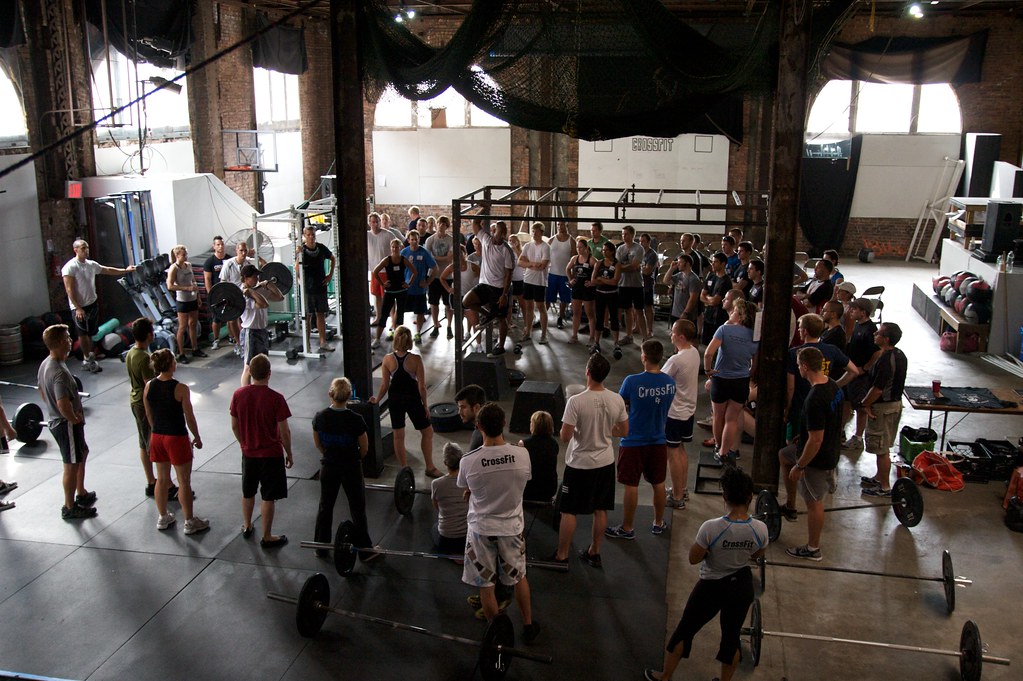
Above is a three-and-a-half minute clip taken from a 20-minute lifting segment we shot. We focused the video on just my talking points to demonstrate how we break down group instruction during Olympic lifting segments in group classes. As discussed in our article "Using Time Stamps to Manage Group Classes," you need to have consistent and effective time management strategies to get large volumes of people through each class in a clear and practical way. That article addressed our time stamps in general, but leading lifting segments for Olympic lifts is a bit more nuanced. You need to take classes through synchronized skill work as a group in order to effectively communicate points of performance.
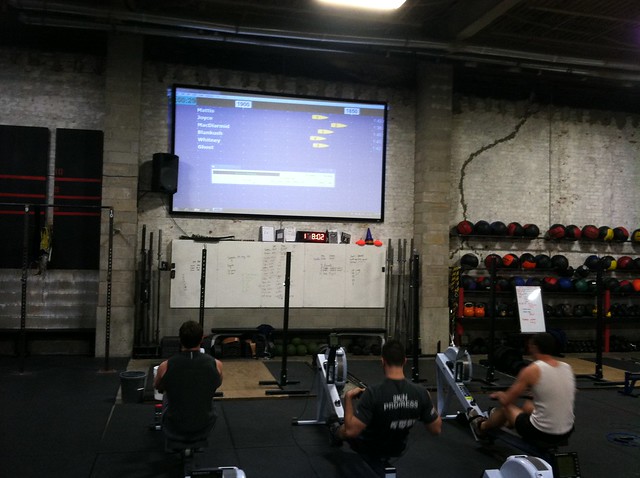
We guess it's cool if you didn't waste hours upon hours of your life playing Mario Kart 64 during the late 90's... but we sure did. Revisiting the obsessions of one's past can sometimes be disappointing, but not in this case. Last Sunday evening, CFSBK hosted our first Mario Kart 64 Tournament (maybe the first Mario Kart 64 tournament ever hosted at a CrossFit affiliate?). We were able to pull off this event because we purchased a 180" screen and projector a couple years ago for the gym.
As you can see in the photos, we hung the projector on some bare wall space next to our racks for wall balls and above a few lifting platforms. The projector and its installation weren’t cheap, but it was an investment that has paid for itself time and again in rewarding community-building events for our membership. We screen the CrossFit Games every year, and we also host semi-regular movie nights (my favorite of which was The Big Lebowski, when we also provided White Russians for attendees). The screen comes in handy for our in-house Erg races for our CRASH B team, for displaying heats and scores during competitions and events we host, and for screening sporting events like the USAW Nationals or an upcoming UFC PPV event.
The most recent event was our Mario Kart tourney, inducing serious '90s nostalgia. One of our members organized brackets, which led to a final championship match, and all the courses were selected at random (by scrolling blindly).
The basic key to running these events is to find common interests among your membership, pick an ideal time, and then, really—just have a lot of fun. This event happened at the end of our usual Sunday night Open Gym session from 6-8 pm, which is usually a pretty social crowd. We had about 20 people show up to play and hang out. Participants got a WOD in or did some Active Recovery beforehand (and during). We also had plenty of beer, which obviously helped improve all of our driving skills.
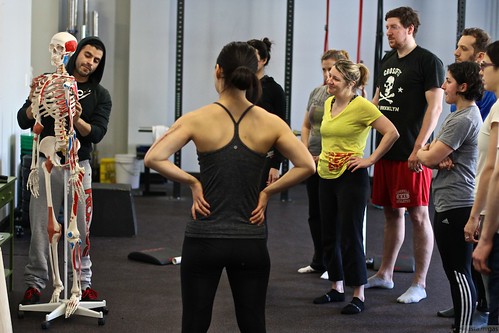
Today's article is about CFSBK’s Active Recovery (AR) class, which is essentially an hour of mobility and soft tissue maintenance that we offer four times a week. The original version of this program started in 2009 when we began hosting six-class workshops to more directly address the movement restrictions we were seeing in our membership. The few minutes of movement prep built into the beginning of group classes was proving insufficient in terms of instructing and enabling our members to really understand their restrictions and learn how to work on them. The goal of implementing specific AR sessions was to help our members establish a routine of DIY work outside of class so they could move and perform better in class.
While the original workshops were successful in terms of selling out and garnering positive feedback from attendees, we gradually realized that an open class format (similar to group classes) would decrease the barriers of entry, by providing hour-long sessions that anyone could hop into for some soft tissue lovin’—as opposed to requiring a three-week commitment limited to the group of people who happened to get into the workshop. These classes have been enormously successful, and our members have seen dramatic improvements in their mobility as a result of both attending class and learning to mobilize regularly on their own.
As we discussed in our post “Building Community Through Your Blog,” a blog is an essential tool for communicating with your members and cultivating an authentic, exciting community. A wonderful way to build community is to recognize various members. Way back in 2010, CFSBK started an Athlete of the Month series. These people certainly aren’t always the most badass athletes in our community, but they are the most coachable, the most helpful to other athletes, the most engaged in our overall community (attending events, etc.), and have the best attitudes about their training. Our coaches converse regularly about which athletes stand out to us for these reasons. Once a month, we pick someone, a coach interviews the person, and we post an edited transcript of their conversation on our blog.
This series is extremely popular, and the blog posts are valuable for our gym primarily because they celebrate and highlight an athlete for whom we’re grateful—and they make our gratitude evident for everyone to see. The posts help other members get to know an influential member of our community, for all the right reasons. Highlighting what we as coaches value about these particular people further reinforces the highest standards of excellence, kindness, and good attitudes that we want to characterize the ethos of our gym.
The Athlete of the Month series implicitly reinforces a value system for our membership, which makes a priceless difference in creating well-rounded athletes and an inclusive, kind, hard-working community that people love being involved with. Check out our most recent interviews here and here.
Try it out with your blogs, and let us know how it goes in the Comments! We promise you’ll be delighted by the results.
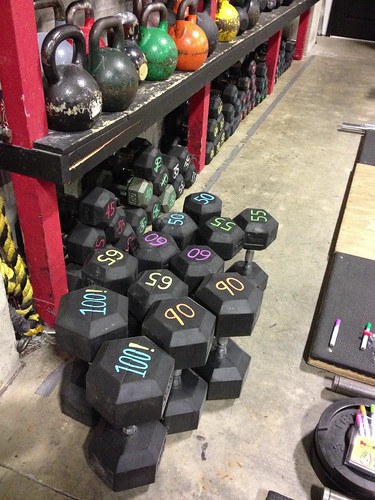
In our first Equipment Hacks post, we discussed labeling barbells, bumpers, and kettlebells. Today's post is a simple fix to a couple common problems in many CrossFit gyms: labeling dumbbells and racks. With a simple set of Decocolor Broad Point Paint Markers, you can easily write directly onto your equipment and create a durable and effective labeling system much to the benefit of your members and anyone with equipment OCD like myself.
Dumbbells Anyone who owns a sizeable amount of rubber-coated hexagonal dumbbells knows what a pain in the ass it can be to keep them organized. More often than not, the only weight labeling on these is an indented mark on one of the small faces of the head, which becomes concealed when the weights are stacked on top of each other. This causes similar weights to be mixed together when members return dumbbells and makes it difficult to quickly scan the inventory to find the pair you're looking for—which becomes especially problematic when a herd of hungry athletes goes searching for weights at the same time. We used the handy markers mentioned above to label and color code the ends of our dumbbells, immediately making them much easier to identify and organize. It was one of those things we did and then kicked ourselves for not having done it years ago.
Starting January 1, CFSBK kicked off our annual Look, Feel, and Perform Better Challenge. While we think that it’s best to act in accordance with your goals and values all (or at least, most) of the time, we also recognize that many people use markers like the beginning of the year to try and create positive changes. The Challenge is extended to the entire CrossFit South Brooklyn community, and is six weeks of a collective kickstart into healthier nutrition and recovery habits. Visit the link above to see our description of the Challenge, along with some forums we set up to help encourage participants and answer questions. We've also included some key details below...
Today's article is for all the newly minted CrossFit coaches out there, eager to share their enthusiasm and passion for fitness with the world. I can't express how much happiness, fulfillment, and fun I've derived from coaching people over the last 10 or so years. On top of that, I've been able to create a career that allows me to spend time with people I care deeply about, doing the things I love, while making a comfortable, consistent living. Yet even after about a decade in the "industry," six years of running a CrossFit affiliate, thousands of coaching hours, and countless lessons learned in the process, I still consider myself a young coach with a lot left to learn—a disposition I hope to maintain for years to come. That being said, there are a few basic principles and challenges I'd like to offer up to anyone just starting their journey as a coach and student of fitness.
Welcome to our first post in ITA's new Spotlight Series. This series will profile excellent affiliates and take a peek into how they do business. We hope this helps shed light on various practices and principles different gyms use to create successful and inclusive programs.
For our first installment, we talked to Nicole Christensen from CrossFit Roots in the beautiful land of Denver, Colorado. Like CFSBK, you may remember CF Roots from the Open announcements last year, or maybe you met Nicole on staff at some of the CrossFit Level One seminar certifications. We hope you enjoy hearing her wisdom as much as we did. Post any questions or thoughts to the Comments!
As we mentioned in our article “Screening Policies for New and Transfer Athletes,” a fairly standard entry point for newcomers into CrossFit affiliates is an introductory course, often named something like Foundations, Elements, or On Ramp. In my opinion, a thorough, well-executed foundations program is one of the best ways an affiliate filters new members into their existing Group Class programs. In this week's article, I'll talk about why I think our Foundations program is so important, describe our philosophical approach to it, discuss some other options, and provide the syllabus for our most current curriculum.
I started CFSBK in a park in Brooklyn—back when very few people knew what CrossFit was—and only five months in I started requiring Foundations courses for new or interested members. Three of those initial few months involved only a handful of people, training two days a week. But at the time I implemented Foundations in early 2008, I'd developed a consistent following of about 10-20 people attending the small number of group classes I offered. Even with such a small group, it was obvious to me that having to review the most elemental features of every exercise as new people showed up was a disservice to my most loyal members. Additionally, it created a potential "wild card" situation for every class, given that someone I’d never met or seen move could show up to any of my group classes.
CFSBK has since run well over 300 Foundations cycles and countless private sessions over the last six years. While the basic template and class structure have evolved (and continue to evolve), the intent of the program remains the same.
In our November article “Continuing Education: Giving Coaches Tests,” we wrote about our ongoing in-house education, and how almost two years ago, I started creating and administering graded tests as an attempt to increase the quality and consistency of our coaching staff. As our gym grew, it became clear that we all needed to be on the same page regarding our basic understanding of the information that we’re accountable for on a daily basis. Christian Fox, one of the coaches who’s been with our gym the longest, just wrote a new test for CFSBK, called “Clean Foundations and Progressions Part 1,” (Part 2 to come!) which can be found below, along with the study guide. Let’s meet Fox and hear some of his thoughts about his test…

 Monday, February 17, 2014 at 12:01AM